
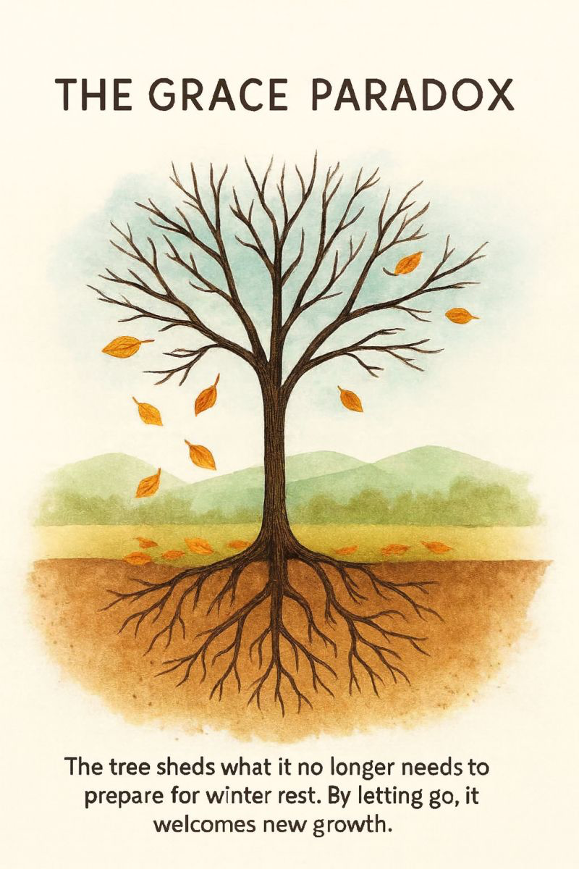
Grace is unearned, yet transformative. We cannot earn it, deserve it, or control it—yet when we receive it, it changes everything.
I think that is wonderful! In my own journey I am learning more deeply about paradoxes and I believe this learning and understanding is important now, more than ever.
Carl Jung saw paradox as a gateway to deeper truth—and in leadership, embracing paradox can unlock authenticity, resilience, and systemic insight.
Jung believed paradox was essential to understanding the psyche and spiritual truth. He wrote that “paradox is one of our most valued spiritual possessions” and that it reflects a higher intellect by honouring the unknowable.
When applied to leadership, this perspective invites leaders to hold complexity rather than resolve it prematurely—a powerful stance in today’s fast-changing, ambiguous world. So, instead of ‘either /or’ Jung invites us to consider a ‘third way’ i.e. a synthesis that emerges when leaders hold opposing truths, and to ‘hold the tension of the opposites’ without collapsing into either.
For example, PwC’s “Six Paradoxes of Leadership” echoes this: leaders must be humble heroes, tech-savvy humanists, and traditioned innovators.
The Grace Paradox , so prevalent in the teachings of the Franciscan monk Richard Rohr, is a beautiful tension at the heart of many spiritual traditions.
In her latest book, Strong Ground, Brené Brown quotes Richard Rohr’s beautiful, loving message – “ that we grow spiritually much more by doing things wrong, than by doing everything right.”
The Grace Paradox , so prevalent in the teachings of the Franciscan monk Richard Rohr, is a beautiful tension at the heart of many spiritual traditions.
In her latest book, Strong Ground, Brené Brown quotes Richard Rohr’s beautiful, loving message – “ that we grow spiritually much more by doing things wrong, than by doing everything right.”The Grace Paradox , so prevalent in the teachings of the Franciscan monk Richard Rohr, is a beautiful tension at the heart of many spiritual traditions.
In her latest book, Strong Ground, Brené Brown quotes Richard Rohr’s beautiful, loving message – “ that we grow spiritually much more by doing things wrong, than by doing everything right.”
And then she says ‘Whew’ … and I love that!
So I want to share some reflection questions for you and I’d love to hear your ‘contemplations’ even if it is a ‘whew’ 😊
- Power in Vulnerability
“Grace enters when we stop trying to earn it.”
Where in your leadership do you feel pressure to “perform” or “prove”? What shifts when you allow yourself—and your team—to be imperfect?
- Holding Tension with Compassion
“Grace holds the paradox: we are both broken and beloved.”
How do you hold space for both challenge and care in your team in yourself?
- Letting Go to Let In
“Grace often arrives through surrender, not strategy.”
What might you need to release—control, certainty, perfectionism—to allow something wiser to emerge?
- Receiving Before Giving
“You can’t pour from an empty cup.”
How do you receive grace in your own life—through rest, beauty, forgiveness, or support?
- Grace as a Systemic Force
“Grace is the connective tissue—it flows between us.”
Where do you see grace operating in your wider system, e.g. team, function or organisation—perhaps in unseen gestures, moments that matter, acts of kindness, quiet patience, or shared laughter?
There is so much to see …without having to look. Whew.
Warmly,
Miriam