
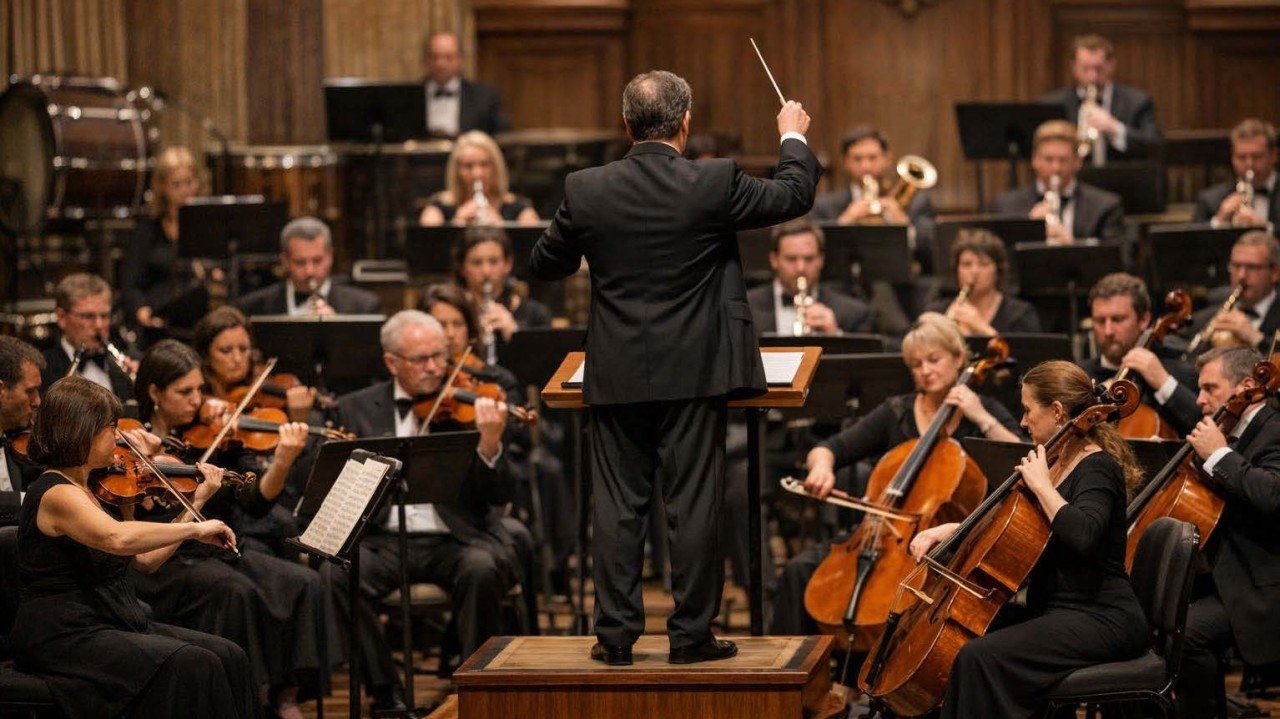
“The conductor of an orchestra doesn’t make a sound. He depends, for his power, on his ability to make other people powerful.” — Benjamin Zander
By Miriam McCallum MSc. MCC, EIA -SP, EISA.
Much of leadership development still treats capability as a collection of separate skills: listening, judgement, challenge, communication and decision-making. Yet senior leadership is rarely won or lost on skill alone. What differentiates leaders in consequential moments is whether those capabilities are aligned, well timed and deployed in service of the wider system. That is why the metaphor of an orchestra is useful. Technical competence matters, but performance ultimately depends on coherence, resonance and presence. In leadership, as in music, the quality of what others experience is shaped not only by what is done, but by the state from which it is done.
What coherence means in leadership
From a neuroscience perspective, coherence describes a state in which different systems in the body operate in sync rather than in conflict. Physiologically, it can be seen in smoother, more ordered patterns in heart rhythms and breathing. Neurologically, it involves more coordinated activity across brain regions, supporting clearer thinking, better regulation and more effective communication.
Using the orchestra as a metaphor, coherence is what happens when the strings, woodwind, brass and percussion are no longer competing for dominance but are following the same score.
In leadership terms, this matters because aligned internal states support better judgement, stronger connection and more consistent performance under pressure. Research on physiological synchrony and coordinated heart rhythms during social interaction helps explain why coherence is not only an individual asset, but also an interpersonal one.
In leadership settings, coherence is experienced as executive presence. A coherent leader is mentally clear, emotionally steady and physically grounded. Their words, tone and behaviour align, much like a skilled conductor whose timing and attention bring the whole ensemble together. Colleagues and teams may not describe this in technical terms, but they recognise its effect: the interaction feels clearer, steadier and more credible.
Coherence in leadership is what allows capability, judgement and presence to operate as an integrated whole rather than as disconnected strengths.
Why coherence is important in leadership
Leadership is not solely cognitive; it is also relational, physiological and systemic. The state a leader brings into the room influences the pace of the interaction, the quality of listening and the degree of trust in the exchange. Just as an orchestra takes its cue from the conductor, teams often take their cue from the nervous system of the person leading the conversation.
When a leader is coherent, the prefrontal cortex—the part of the brain associated with judgement, empathy and perspective-taking—remains more available, while emotional reactivity is better regulated. In effect, the internal conductor stays on the podium. Rather than being driven by tension, distraction or defensiveness, the leader can coordinate attention, emotion and decision-making with greater precision.
First, attention improves. A coherent leader listens with greater depth and accuracy, noticing not only what is being said but how it is being said. They are less likely to interrupt, make premature judgements or impose their own agenda.
Second, emotional capacity expands. Leadership frequently requires steady judgement in the presence of ambiguity, pressure and strong emotion. In coherence, a leader can remain composed without becoming detached or reactive. That steadiness creates space for better thinking, more candid dialogue and more considered decisions.
Third, communication becomes clearer and more effective. Because the leader’s internal signals are aligned, their questions, reflections and even silences land with greater precision. This congruence is often experienced by colleagues and teams as credibility, authority and trust.
Finally, coherence supports psychological safety. People continuously scan for signs of threat or stability. A regulated, coherent leader signals consistency and calm, reducing defensiveness and enabling more direct, productive dialogue.
How resonance spreads through the room
One of the most important features of coherence is that it does not remain contained within the individual. Like resonance in an orchestra, it travels through the wider system.
Human beings are wired for forms of emotional and physiological synchrony. Through mirroring, attunement and other social processes, we unconsciously pick up and reflect the states of others. In an orchestra, one section that drifts off tempo can unsettle the whole performance; equally, one grounded musician can help stabilise the ensemble. Research suggests that coordinated physiological patterns can emerge between people during interaction, helping explain how one person’s state influences the cohesion of a group.
This is why presence matters in leadership. A coherent leader does more than regulate themselves; they shape the emotional tone, pace and quality of thinking in the interaction, much like a clear tuning note that helps an ensemble settle.
In leadership, this means that your state is not neutral—it actively shapes the state of the other person or group.
Leadership climate: how a leader’s internal state affects others
“The success of an intervention depends on the interior condition of the intervener.”
– –Otto Scharmer, quoting Bill O’Brien, former CEO of Hanover Insurance
The resonant quality of a leader’s state has direct implications for what other people can access in an interaction.
People often, in effect, ‘borrow’ the nervous system of the leader. When that person is calm, steady and present, breathing may slow, thoughts may become more ordered, and people are better able to reflect rather than react. This creates a climate in which people can flourish. When the leader is tense, distracted or rushed, the interaction can feel like an orchestra warming up without ever finding the downbeat. This can create a frazzled climate of tension, stress and defensiveness.
Leaders also set the climate of the meeting or conversation, or indeed any intervention. Before a single question is asked, tone, pace and presence establish what is possible. In this sense, the quality of other people’s thinking is often shaped by the leader’s internal organisation. When the leader is coherent, the interaction has structure without rigidity, openness without drift, and energy without strain.
Coherence also supports better thinking. A more regulated nervous system improves access to higher-order capacities such as insight, perspective-taking and meaning-making. This helps explain why people often report greater clarity in a calm leadership environment: the setting is not only psychologically safer, but biologically more supportive of reflection and connection.
Over time, this has a developmental effect. As people repeatedly experience a regulated, coherent leader, they begin to internalise that state themselves. They learn—often implicitly—how to regulate their own thinking and emotions beyond the interaction. People are not only copying a behaviour; they may gradually develop a deeper capacity for regulation, reflection and perspective-taking. This is part of vertical development: the gradual expansion of a person’s capacity to make sense of complexity, regulate themselves under pressure, and respond with greater perspective, maturity and systemic awareness.
Why leadership presence matters: a Theory U perspective
Theory U offers a helpful language for understanding why leadership presence matters so much. In Otto Scharmer’s account, the deepest variable in leadership is not only what a leader does, but the inner place from which they operate. He argues that the quality of attention and intention a leader brings into a situation shapes what becomes possible in that system. In that sense, presence is not a soft extra; it is part of the mechanism by which leadership influences perception, trust, choice and action.
A central idea in Theory U is presencing, a blend of presence and sensing. It describes the capacity to attend deeply enough that we are no longer merely reacting from habit or downloading from the past but are able to sense what is emerging and respond with greater awareness. For leaders, this matters because many organisational challenges cannot be met through technique alone. They require the ability to suspend automatic judgement, listen beyond surface positions and notice the future possibilities that are trying to take shape.
Theory U also highlights three leadership capacities: an open mind, an open heart and an open will. Leadership presence supports all three. It helps leaders keep an open mind by loosening the grip of old assumptions; an open heart by making empathic listening and genuine connection more possible; and an open will by increasing the courage to let go of familiar identities or solutions when they no longer serve. Without presence, leaders are more likely to revert to defensiveness, control or premature certainty. With it, they are better able to stay in contact with reality as it unfolds.
Another important contribution from Theory U is the idea of the social field: the relational and attentional conditions that shape how people think, speak and act together. Leadership presence matters because it influences that field directly. A leader who arrives rushed, defended or performative narrows what others can say and think. A leader who arrives grounded, curious and genuinely attentive opens up the possibility of deeper listening, better collective sense-making and more creative response. Presence therefore has systemic consequences. It affects not only the leader’s own performance, but the quality of the shared space from which decisions and action emerge.
Seen through this lens, leadership presence is not simply about appearing confident or composed. It is about cultivating the conditions in oneself that allow better attention, wiser perception and more generative action to arise. Theory U reminds us that, especially in complexity, the future is often shaped less by the force of a leader’s answers than by the quality of presence from which they ask, listen and act.
From isolated technique to ensemble mastery: Embodied Presence

The diagram suggests a broader way of understanding leadership development. It brings psychology, systems thinking and science together to show how embodied presence is cultivated. Psychology illuminates the inner capacities involved, systems thinking locates leadership in the wider relational field, and science explains the physiological and neurological foundations of coherence and regulation. Together, they offer an integrated account of presence as something that can be intentionally developed.
It is not simply a matter of accumulating more tools or techniques, as though stronger leadership were achieved by adding more instruments to the stage.
The deeper task is to develop the quality of presence that allows those capabilities to work together with timing, judgement and discipline. A leader’s state is not separate from performance; it is what turns individual strengths into coherent execution.
It begins with coherence
The encouraging news is that coherence is not an innate advantage reserved for a few. It can be developed. Just as musicians rehearse timing, listening and coordination before a performance—and tune in to one another before it begins—leaders can strengthen the conditions that support coherence: deliberate breathing, centring, attentional control and the intentional cultivation of curiosity, composure and perspective. These practices help the nervous system settle into a more ordered state and make executive presence more available under pressure.
For leaders, even a brief pause before a meeting, decision or difficult conversation to reset attention, regulate breathing and establish intention can improve the quality of the exchange.
In practice, this might include a simple pre-meeting routine: two or three minutes of slow, coherent breathing—for example, inhaling for five and exhaling for five or six; feeling both feet on the floor to ground attention in the body; relaxing the jaw and shoulders; noticing any internal tension without trying to fight it; and choosing a clear intention for how you want to show up, such as calm, curiosity or compassion.
A brief leadership Presencing Practice
- Pause and arrive. Let your attention settle, and notice your posture, jaw and shoulders.
- Breathe coherently. Inhale for five and exhale for five or six for two or three minutes, without forcing the breath.
- Ground your body. Feel both feet on the floor or your contact with the chair, and allow your body to soften.
- Widen awareness. Notice a few sounds in the room or sensations in the body so your attention becomes steadier and less narrow.
- Choose your intention. Before the meeting or conversation begins, name the quality you want to bring, such as calm, curiosity, compassion or courage.
The future of leadership may depend less on adding more capability and more on creating greater internal coherence.
When leaders cultivate coherence, resonance and presence, they do more than improve their individual performance. They create the conditions for clearer thinking, stronger judgement and more constructive behaviour in others. Like a well-led orchestra, effective leadership becomes more than the sum of its parts: it becomes an organising force that others can feel, trust and follow.
……………………………………………………………………………………………………………………………………………
References
Scharmer, O. C. (2016) Theory U: Leading from the Future as It Emerges. 2nd edn. San Francisco, CA: Berrett-Koehler Publishers.
McCraty, R. (2015) ‘Coherence’, in Science of the Heart. Boulder Creek, CA: HeartMath Institute.
Zak, P. J. (2017) ‘The neuroscience of trust’, Harvard Business Review, January–February.
Goleman, D., Boyatzis, R. and McKee, A. (2002) Primal Leadership: Realizing the Power of Emotional Intelligence. Boston, MA: Harvard Business School Press.
Petrie, N. (2013) Vertical Leadership Development – Part 1: Developing Leaders for a Complex World. Greensboro, NC: Center for Creative Leadership.
Kegan, R. (1982) The Evolving Self: Problem and Process in Human Development. Cambridge, MA: Harvard University Press.